Soccer Rankings
- 4.7
- Rating
- 10.00K
- Installs
- Free
- Price

 Analysis by App-foxy
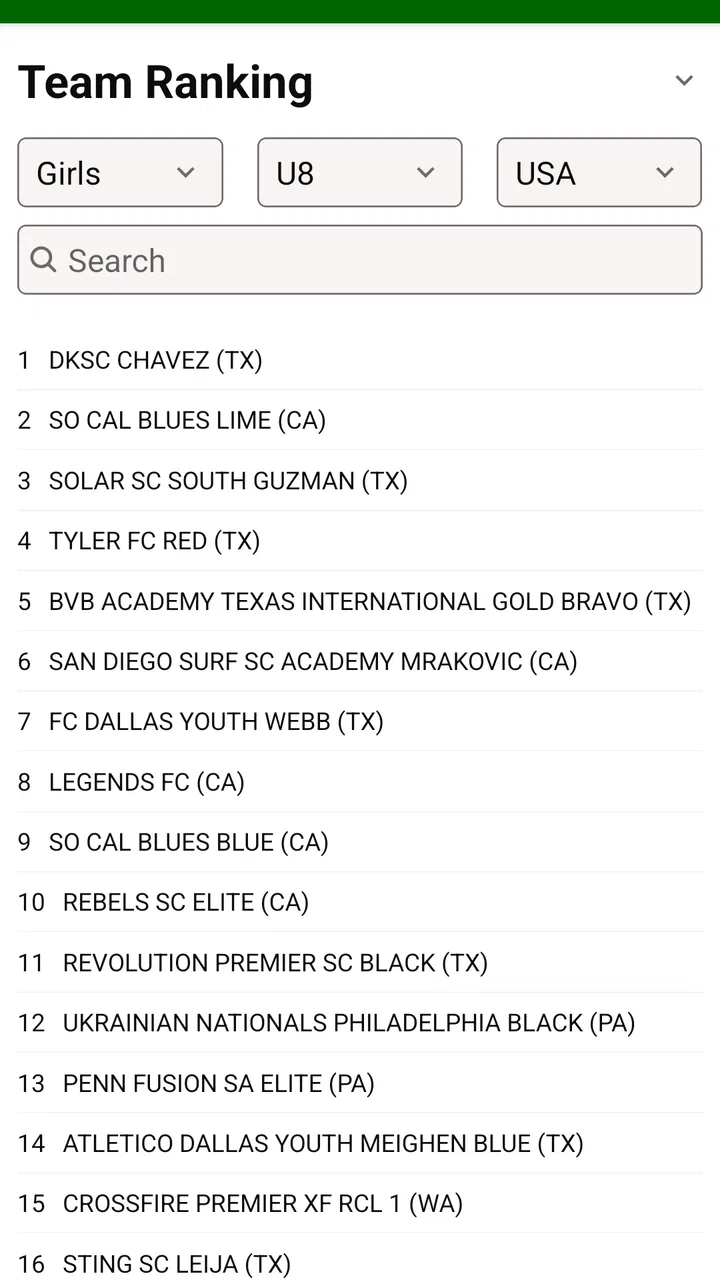
When I first opened Soccer Rankings, I approached it with a very specific question: how can I quickly understand where a USA youth soccer team stands without digging through scattered pages or relying on a coach’s memory? That starting point matters because this is not a training planner, match tracker, team communication tool, or general soccer news app. It is a focused sports app from USA Sport Statistics built around rankings for youth teams in the United States.
That narrow purpose is also its main appeal. If I am a parent comparing possible opponents, a coach preparing for a tournament, or a player who wants a clearer sense of the competitive landscape, I do not need a large collection of unrelated features. I need a direct way to look up ranking information and turn it into a useful conversation. The app is free to download, aimed at Everyone, and has reached over 10 thousand installs. Its average rating is 4.7 from around 80 ratings, which suggests that its focused approach works well for a small but interested audience.
From a vague question to a useful ranking check
The most realistic way to use this app begins before opening it. Imagine that my child’s team is considering a tournament, or that I am trying to understand whether an upcoming opponent is likely to be a close match. I may know the team name, the club, or the general youth soccer context, but I may not know exactly where that team fits nationally. Soccer Rankings gives me a place to begin that search instead of forcing me to assemble an answer from several unrelated sources.
You May Also Like

 Blood Strike: 2.5 Anniversary
Blood Strike’s Loadouts Turn Every Drop Into a Tactical Gamble
A close look at Blood Strike’s custom loadouts: how fast access to signature weapons reshapes its battle royale rhythm, rewards preparation, and narrows the gap between fights.

 Pandora - Music & Podcasts
Pandora’s Music Is Easy to Start, but Harder to Recover
Pandora’s strength is its low-effort path from a seed to a station. Its weak spot is how much confidence it asks you to place in connection, setup, and quiet recovery.

 8 Ball Pool
 Is Built on Rivalries, Rematches, and Routine
A close look at the rivalries, rematches, shared routines, and unanswered safety questions that turn a quick pool match into a persistent mobile community.

 Samsung Music
’s Quiet Strength Is Playing What You Already Own
Its reach comes less from spectacle than from dependable access to a personal library. That simplicity is both the app’s strongest retention engine and its ceiling.

 AccuWeather: Weather Radar
AccuWeather Review: A Quick, Clear Forecast for Everyday Decisions
For everyday plans, the best forecast is the one you can understand quickly. AccuWeather makes rain timing, radar, and local conditions easy to act on, with a few trade-offs.

 Hill Climb Racing
Why Hill Climb Racing Still Turns Crashes Into One More Run
A tiny car, a bumpy hill and one more upgrade: Hill Climb Racing keeps resurfacing because its simple chaos makes every near-miss feel personal.
More From Our News Desk
View All News


My first practical tip is to treat the app as a reference point rather than an absolute verdict. A ranking can help organize a conversation, but it should not replace looking at recent form, age group, travel level, tournament results, or the particular competition format. Youth soccer changes quickly, and a position on a list cannot describe every strength or weakness of a team. The app is most useful when I use its information to ask better questions.
The opening workflow is intentionally simple in concept: identify the team I care about, locate its place in the rankings, and then interpret that position in context. That sounds obvious, but it creates a helpful discipline. Instead of beginning with a broad internet search and getting lost in club pages, social posts, and tournament advertisements, I can start with one organized source. The result is not a complete scouting report, but it is a cleaner first step.
For a parent, this can reduce uncertainty before a conversation with a coach. For a coach, it can provide a quick reference while considering tournament strength or possible opponents. For a player, it can make the wider youth soccer scene feel less abstract. I would not use the app to decide whether a child should move clubs or whether one team is automatically better than another, but I would use it to prepare for those discussions.
How I would work through a team lookup
I would begin with the exact team identity rather than typing the first name that comes to mind. Youth soccer often includes similar club names, multiple age groups, and different teams under the same organization. The useful handoff here is from my real-world knowledge—club, age group, and competition setting—into the app’s ranking view. If I skip that preparation, I risk drawing conclusions from the wrong team.
Once I find the relevant ranking information, I would pause before sharing it. The important question is not simply “What number is shown?” but “What decision am I trying to make with this?” If I am comparing tournament possibilities, I might note the relative standing of several teams. If I am discussing progress with a player, I might use the ranking as one small piece of encouragement rather than presenting it as a judgment of personal ability.
This is one of the app’s less obvious strengths: it can turn a loose sports conversation into a repeatable process. I can start with a team name, check the ranking, write down the useful context, and pass that information to someone else. That makes the app more valuable for families and coaches who regularly compare teams than for someone who only wants casual soccer news.
A second practical tip is to record the context alongside the ranking when using it for planning. I would note the age group or club identity in my own message or notes, because a ranking number without context can easily be misunderstood later. The app’s focused presentation helps me find the information, but the responsibility for explaining it still belongs to me.
Where the handoffs happen in everyday use
The most useful part of the workflow often happens after I leave the ranking screen. A parent might send the information to another parent before registering for a tournament. A coach might bring it into a staff discussion about possible opponents. A player might ask why another team appears higher and start a conversation about competition. In each case, the app is the starting point, not the entire process.
Consider a Saturday morning scenario. My child’s team is due to play later, and a parent asks whether the opponent is considered strong. Rather than offering an uninformed answer, I can check the relevant team in Soccer Rankings, explain the position I found, and add that rankings do not tell us everything about the specific match. That is a more responsible answer than either dismissing the opponent or assuming the ranking guarantees the result.
There is also a useful handoff between coach and family. A coach may already understand the competitive details, while parents may only see scores or hear brief updates. A shared ranking reference can give everyone a common starting point. I would still want the coach’s direct assessment, especially when the ranking does not reflect injuries, roster changes, tactical style, or the conditions of a particular tournament.
The app can also help when a player is trying to understand progress over time. I would be careful here. A ranking should not become a source of pressure or a substitute for constructive feedback. Used well, it can show that youth soccer includes a broad range of teams and that improvement is better measured through habits, teamwork, and performance than through one displayed position.
Because the app is free, it is easy to make it part of a low-commitment workflow: check it before a discussion, use the information, and move on. That is different from a subscription-heavy sports platform that expects me to build my whole routine around it. The trade-off is that I should not expect the same breadth as a full club-management or match-analysis product.
What the ranking result can and cannot tell me
The outcome I get from Soccer Rankings is a clearer reference point for USA youth soccer teams. That is genuinely useful, especially when I need a quick national perspective instead of a local impression. A team that looks dominant in one small league may face a very different level of competition elsewhere, and a broader ranking can help me think beyond the immediate schedule.
Still, I would not confuse a ranking with a prediction. It cannot, by itself, tell me how two teams will match up stylistically, whether the players are available, or how the game will unfold. A lower-ranked team may defend effectively against a particular opponent, while a higher-ranked team may struggle on a given day. The best use is comparative and exploratory: the ranking helps me decide what to investigate next.
This distinction is especially important for parents. If a child is choosing between clubs, I would use the app to understand the competitive environment, then ask about coaching, playing opportunities, travel, cost, team culture, and development. A ranking can make one club look attractive at first glance, but it cannot answer whether that club is the right fit for a particular player.
For coaches, the trade-off is similar. The app may save time during early tournament research, but it should not replace video review, direct scouting, or conversations with other coaches. Its value is greatest at the filtering stage, when I want to narrow a large set of possibilities before doing deeper work.
For players, I would recommend using the result as motivation rather than identity. Seeing a team’s position can encourage curiosity about how strong programs train and compete, but it should not define a player’s worth. That may sound like a small distinction, yet it changes how responsibly the information is used at home and in the locker room.
Practical friction and situations where I would skip it
The app’s specialization creates its biggest limitation. Someone looking for live scores, fixtures, team messaging, workout plans, player statistics, or detailed match analysis will probably need another tool. Soccer Rankings is not the right choice if my main goal is to manage a team’s daily operations or follow a match minute by minute.
I would also skip it when I need a fully local answer and already have reliable league-specific information. A coach who knows the regional competition intimately may gain little from a broad ranking check, particularly when the immediate decision depends on details that a national list cannot capture. In that case, direct league records or personal scouting may be more useful.
Another point of friction is interpretation. The app can make ranking information easy to consult, but it cannot prevent users from treating the result as a final judgment. I have to bring the context myself. That means checking that I have the right team, keeping the age-group distinction clear, and avoiding dramatic conclusions from a single lookup.
The current version is 5.1.1, and the app supports devices running Android 7.0 or later. That makes it accessible to many older Android phones, which is convenient for families who are not using the newest hardware. At the same time, anyone on an older unsupported system would need to consider device compatibility before planning around it.
There are in-app purchases priced at $9.99 per item. Since the app itself is free, I would start with the basic experience and only consider an optional purchase if it clearly supports the way I use the rankings. For a parent checking an opponent occasionally, paying may not be necessary. For a coach who returns to the app often, an additional purchase could be worth considering, but I would judge that by practical value rather than assuming every paid item is essential.
Who gets the most from this focused sports app
I think Soccer Rankings is best suited to people who need a quick national reference for USA youth soccer. Parents researching tournament competition, coaches comparing possible opponents, club staff preparing conversations, and players curious about the broader competitive picture all have a clear reason to try it.
It is particularly useful when the starting condition is uncertainty rather than a need for deep analysis. If I know a team’s name but do not know how it compares with others, the app gives me a structured place to begin. If I already have detailed scouting information and only need live match tools, its role becomes much smaller.
The developer, USA Sport Statistics, has kept the concept focused enough that I can understand the app’s purpose immediately. That clarity is valuable. Many sports apps try to combine news, scores, social features, fantasy tools, and statistics, which can make a simple lookup feel unnecessarily busy. Here, the central task remains easy to explain: use the app to investigate youth soccer rankings, then apply the result carefully.
The audience rating of Everyone also fits the way I would use it around a family soccer schedule. It is not presented as an adult-only betting or entertainment product; it is a reference tool that can support ordinary conversations about youth competition. Even so, adults should guide younger players in how they interpret rankings, especially when competition results affect confidence.
My final workflow and recommendation
My preferred workflow is straightforward. I start with a real question, confirm the team identity, check the ranking, write down the context, and then hand the information to the person who needs it. After that, I add the details the ranking cannot provide: recent performance, coaching quality, roster situation, playing style, and the player’s own goals. This keeps the app useful without asking it to do a job it was not designed to do.
Compared with a general soccer app, Soccer Rankings is more focused and therefore faster for this particular task. Compared with league pages or informal online discussions, it offers a more organized starting point. Compared with a full team-management platform, it is much narrower, but that can be an advantage when I only need rankings and do not want a complicated system.
My recommendation is simple: use it as a ranking compass, not as the whole map. It is a good free choice for anyone who regularly needs perspective on USA youth soccer teams, and its 4.7 average from around 80 ratings reflects a positive reception among its audience. I would install it before tournament research or a club-comparison conversation, while keeping my expectations realistic about the limits of rankings.
After using it, I am left with a practical impression rather than an exaggerated one. This is a specialized sports app that can shorten the distance between a vague question and a useful starting answer. It works best when I treat the displayed ranking as evidence to discuss, not a conclusion to obey. For that workflow, Soccer Rankings earns a place on my Android device; for live match coverage, detailed player analysis, or complete club administration, I would look elsewhere.
FAQs for Soccer Rankings
01What is Soccer Rankings, and what does the app offer?
Soccer Rankings is designed for football fans who want quick access to team standings, rankings, and competition-related information in one place. During testing, the app was useful for checking how clubs and national teams compare across different leagues or tournaments. Depending on the available competition, users may also find match results, team statistics, rankings history, and other details that help explain a team’s current position.
02How accurate and frequently updated are the rankings in Soccer Rankings?
The usefulness of Soccer Rankings depends heavily on how regularly its data is refreshed. In general, rankings should reflect official results and recent performances, but updates may not appear immediately after a match finishes. If you need information for betting, fantasy football, or professional analysis, it is sensible to compare important figures with an official league, federation, or competition website before making decisions based on the app.
03Can I follow specific teams, leagues, or competitions?
Soccer Rankings is most convenient when you are interested in particular clubs, national teams, or competitions rather than browsing every available ranking manually. Depending on the version and platform, the app may provide filters, search tools, or personalized sections for narrowing the information. Before downloading, check whether the leagues and ranking systems you follow are supported, especially if you watch less popular regional competitions.
04Is Soccer Rankings free to download and use?
Soccer Rankings may be available as a free download, but the exact experience can depend on the platform and version installed. Free apps commonly include advertising, optional purchases, or limitations on certain features and detailed statistics. We recommend checking the Google Play Store or Apple App Store listing for current pricing, subscriptions, and in-app purchase information so there are no surprises after installation.
05Does Soccer Rankings require an internet connection?
An internet connection is generally recommended because rankings, match results, and team information need to be retrieved or synchronized with current data. Some previously loaded content may remain visible temporarily, but offline access should not be assumed unless the app clearly provides a download or caching option. Mobile data usage is usually modest, although frequent refreshing and image-heavy content can consume more data over time.
Pros
- Covers league tables and team positions in one convenient app.
- Quick access to recent results and upcoming fixtures.
- Simple layout makes rankings easy to scan on mobile.
- Useful for following multiple competitions in one place.
- Lightweight app that opens quickly on most devices.
Cons
- Coverage may vary between leagues and competitions.
- Some statistics may update later than official sources.
- Advertising can interrupt browsing in the free version.
- Limited analysis compared with dedicated football statistics apps.
- Requires an internet connection for current rankings and results.

Soccer Rankings
Gallery